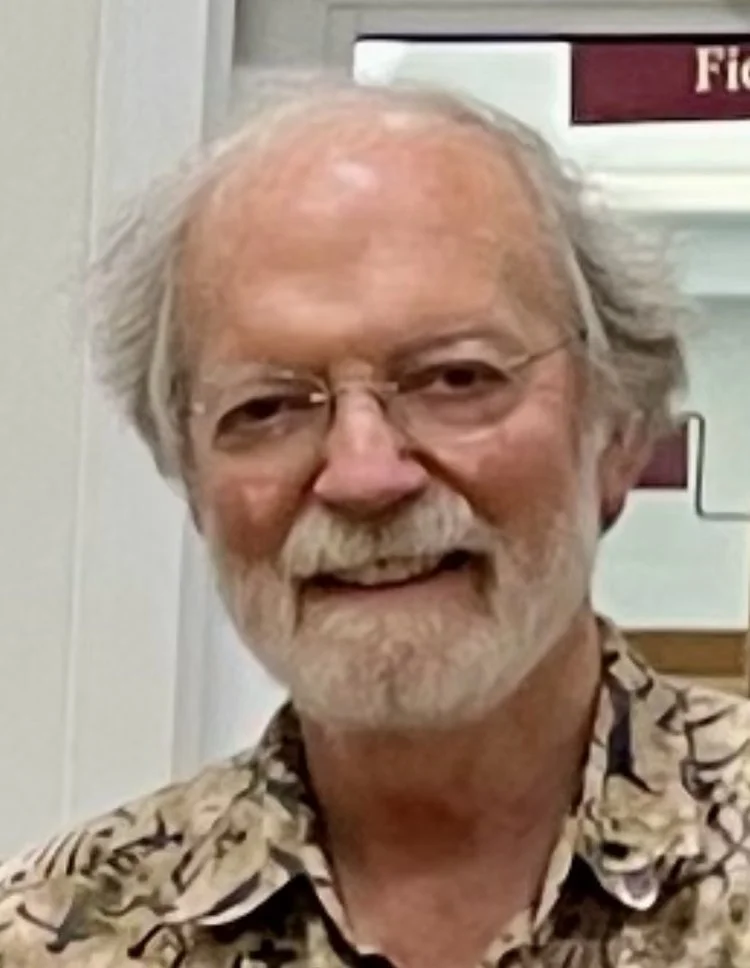
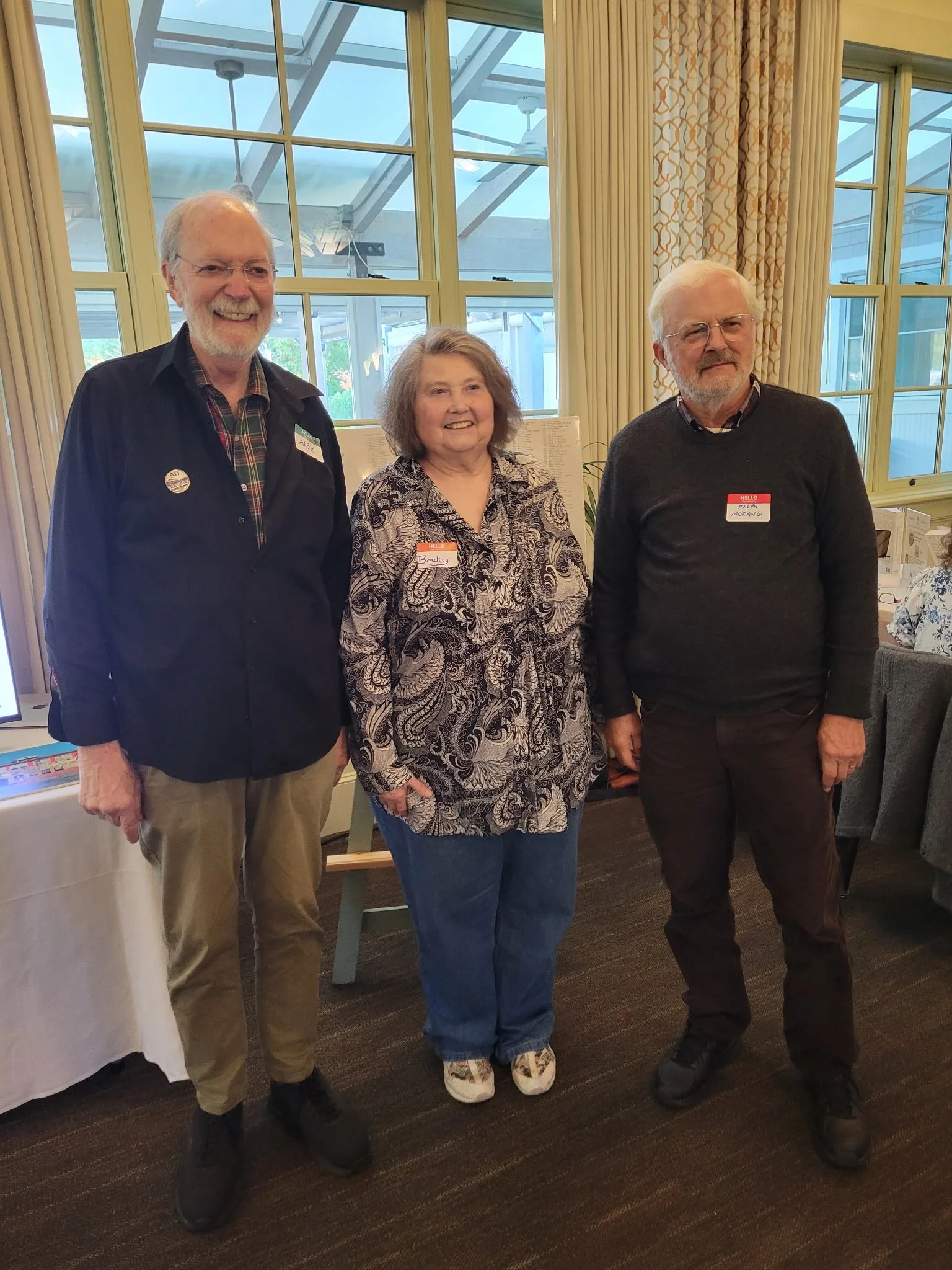
Founding members (L-R): Alex Herlihy, Becky Marden, Ralph Morang
Introduction
Welcome to this great celebration of Rye history and the society that has done so much to promote it in the last half century. In 1976 the country was in dire need of a celebration, given the difficult time we found ourselves in then. But it was not the national celebration that really shone back then, but how the 20,000 communities that make up the country recognized the event. Ther was a great revival of interest in local history, inspired by the revolutionary openness and inquiry of the 1960s.
It is always good to remember on whose shoulders we stand, and RHS was fortunate that groups and individuals had been preserving Rye history for centuries. Stories and anecdotes, town government and church history, newspaper recorded events and more was collected and given back to the public. Two shining examples are a century sermon in the early 1800s by Huntington Porter detailing Rye’s 1700s history Rye’s first history by Langdon Parsons in 1905. o
When that book was published the Rye Every Other Tuesday Club was in full swing sponsoring events at Town Hall and collecting Rye history. EOTC was part of the early 1900s Progressive Era when women and their groups played a significant role in supporting needed reforms it the country. And it was through the EOTC that jessie Herlihy, Louise Tallman and others began researching old houses and even sponsored a kitchen and garden tour in 1954, just the kind of activities that RHS would carry on from1976. Another precursor of RHS was the book by town historian Bill Varrell in 1962: “Rye on the Rocks: The story of a town that resorted to resorting.” Bill would go on to write two more Rye history books and become my mentor and a favorite presenter of RHS with his slide shows and wonderful anecdotes.
Chapter 1
Most towns had a Bi-Centennial Committee with some federal funding and aside from how they would plan the Bi-Centennial in their town, the long- term goal was to create something permanent. Ralph Morang was the chair of Rye’s committee and member Jessie Herlihy suggested that a historical society be established, a natural outgrowth of that committee. And so, it came to pass in February 1976 and you can see some of the charter members in this photo with a rep from the NH Historical Society.
What did they do in their first year? At once the Rye public library became their home for public programs, exhibit space and storage of items that had been in people’s homes. And when the society was a mere five months old is sponsored a huge house tour that summer with the Garden Club, a huge and successful event followed by four more before the end of the century. I had just moved into my old house “Marston House” in 1976, which I had dismantled in Hampton and moved to Rye in 1975, and it was on the tour. Louise and Jessie and others continued to document old houses and dug deep into restoring the town’s 40 historic family graveyards. The society also began fifty years of programs at the library, some of which you read about in the October newsletter. For its members, RHS printed little yearbooks listing officers, committees, members and programs. Thanks to Ralph Morang Jr and others, RHS was given historic glass plate negatives taken by Rye photographers ARH Foss and Clarence Treffry, which UNH printed, thus giving a vibrant, visual imprint to Rye’s past. The group was off and running.
In 1979-80 Marcia Gillis wrote and published a bi monthly newspaper called The Rye Free Press, the only known newspaper the town has ever had. The museum has all the issues, one of the most well documented years in town history.
In 1985 RHS mounted one of the biggest events in its history – the celebration of the Town’s Bi-Centennial. Wait – didn’t we just have a Bi-Cent nine years ago?! No, that was the country, this was for the town, when the Parish of Rye became independent in 1785. This three- day event began with public interviews and discussion with town elders sharing some oral history, followed by a two- day event in the Town Hall auditorium. Somehow RHS begged, borrowed and found an amazing collection of Rye historical artifacts and various other displays for tables that filled the historic hall. John Philbrick loaned his bog shoes that horses used to harvest salt marsh hay and later donated them.
Bob Stevens even walked his RJJH social studies students up to take it all in. The town turned out in record numbers and packed the hall, one of the greatest public celebrations of the town’s past. Imagine the conversations, the stories, and the humor as old timers and others regaled anyone who would listen to their tall tales of long ago and more recently. To reward RHS, the town offered exhibit space around the perimeter of part of the auditorium where town government meetings were now held, with the other half now housing temporary office space. Rye had its first museum, but the town had lost its historic meeting space, which we hope in my life time to restore.
Chapter 2.
By the late 80s some of the early energy had gone from the society and when my mother died in 1989 the group found itself at a crossroads. An emergency meeting was held at Gene Ritzos historic cape home on Central at Locke. What emerged was a new sense of purpose and in 1990 the society published its first book: “Rye and Beyond: The Poetry of Jessie Haig Herlihy.” The first 13 poems are about Rye history, inspired by her reading of Langdon Parsons’ Rye history.
The last yearbook was printed in 1991, but no programs were listed. Bonnie Goodwin and I were appointed co-chairs of the board which included Becky Marden and treasurer Ellie Stewart. RHS continued somewhat as before, but the main goal was the search was on for a building to renovate as a museum, and Raph Morang III helped take the lead with that in 1995 as the library expansion plans became public.
The town donated a cape style building adjacent to the library to RHS, which had been built in 1930 as an antique shop and later used as apartments. In 1997 the library moved the building a short distance from its original site and over the next five years, Bonnie Goodwin oversaw its renovation at a cost of $74,000. RHS had been raising money with house tours and received some generous bequests which backed the project. In 1998 RHS sponsored its most successful house tour of all which put the society over the top to finish the museum.
In July of 2002 the museum had its grand opening with a generic history of Rye exhibit and a whole new era of Rye history had begun. A regular stream of visitors came during Saturday scheduled hours and more often by appointment and since we were often working in the building people dropped in whenever the door was open. Rye had a new community center. Susan Ki9dnstedt became our archivist and with a Moose plate grant from the state she archived all the town records that had been given to RHS after the museum opened. Susan, Bonnie and I created our first professionally done exhibit in 2005: “Summering in Rye: Over a Century by the Sea.”
Chapter 3
When Bonnie Goodwin died in 2006 at age 66, the society had lost another friend and invaluable leader. I became president, but when Bill Varrell died in 2007, I had lost the two people I had been talking with for many years, who were as deep into Rye history as I was. Thanks to Becky and Margaret Carroll, Mary McCue, Alice Provencher, and other board members, we carried on. In 2007 RHS received its largest bequest from John Adams (Seavey family connection), who had died at his home in California. His nieces delivered the check to Louise Tallman at the museum and it insured the society would remain solvent in the future.
In 2008-2009 UNH Museum Studies intern Lindsay Burke mounted a new Rye history exhibit and she stayed on as a part- time employee to set up our web site and continue archiving, using the Past Perfect software on the museum computer. With the arrival of Steve Cash in 2010 we had a bona fide treasurer again and I had a new Rye history buddy to talk with about the town’s early history at Odiorne Point. The Rye History Trolley tours began in 2011, at the suggestion of a 4th grader after his class had such a tour. For the tour I made a two-page Rye history timeline, which quickly grew to 100 pages and became the catalyst for beginning my new history of Rye. From 2013 to -2015 we had two more UNH students who gave us invaluable help in exhibits, newsletters and archiving. In 2014 RHS board member took the lead in creating a new town flag which corrected the three key dates of Rye history: 1623- European settlement; 1726 – Parish of Rye established; 1785 – independent town status granted by state of NH.
It was about this time that I reconnected with Jo Kirkham from Rye, East Sussex, England, who had come to Rye on a “state visit” as mayor in 1981 and my family visited her Rye a few months later. By 2014 Jo was my counterpart at the Rye Museum assoc. and you can red her account of Rye England in my book. In 2015 RHS joined with RPL and RJH to wrote a grant that funded “Access Rye History,” a selection of primary source Rye documents between 1850 and 1920 that can be found on our website. Also, at this time I began receiving Rye history memories from David Mahar in CA and you can read these very humorous stories in my book.
In 2016 we got four Farragut hotel cocktail glasses in the mail which waiter Ed Parasisio had appropriated at the end of the summer of 1966. Ed wrote a memoir of that halcyon time in his life which you can read on my web site: Ryehistoryrocks.com. (under tab “Topics” – Farragut waiter). Also, that year RHS published its second book: Rye’s Battle of the century: Saving the Seacoast from Olympic Oil, by Lisa Moll of Rye. This garnered much attention for RHS and gave a long- deserved account of Rye’s positive role in the defeat of the oil refinery proposal of 1974.
Chapter 4
Through the years RHS has brought Rye history to both Rye schools and in 2023 RJH invited me in for the year to work with students on Rye topics for the Rye400 celebration. It was those students who encouraged me to start my own website – Ryehistoryrocks.com which complements the RHS web site.
Roger Philibrick is a descendant of his founding family who settled here in the 1600s and he has been researching and recording 20th century topics for years and in the last few years has been prominent in public programs, material on RHS web site and articles in Stroll magazine.
By 2018 I was exhausted from leading RHS for 12 years and trying to write my new Rye history book. Deb Toohey and her husband Garrit had become connected to RHS through a grant they gave the society to research their house on Sea Rd, a former 14 room hotel, called the Rye Beach Inn. Deb joined the board and then took over as president, followed by Janet Davis, Ginna Macdonald and current president Andy Stecher. I am grateful to them all, not to mention all the other new board members who have joined in the past decade to bring the historical society to where it is today. The 19th century exhibit followed by the current Rye in the 20th century exhibit are directly related to this new blood on the board. And what a job Andy and the board did on Rye 400 in 2023, publishing my book in 2025 and all the programs and events for this year’s 300th anniversary celebrations.
Conclusion
During my 24 years in the museum, I have greeted untold numbers of visitors and learned so much Rye history from them, both those who live here or used to live here. To all of them I owe much. And over the past half century I am indebted to all those who have been involved at RHS, board members, volunteers and regular members. I also want to thank the staff of the Rye Public Library for all their years of support and cooperation with RHS. The future for the society and Rye history is bright indeed and we hope all of you will find a way to join us in continuing to bring it to life.
RHS 50th Anniversary Poem
Once upon a time
In days of old
Rye history rose up
With historians so bold.
Jessie, Louise and Ralph
Bonnie, Becky and Esther
To those society founders
You were no court jesters!
Digging up the past
For history they were on guard
Over the decades they labored
Old photos, houses and graveyards.
They roamed and they rambled
Ever expanding Rye history friends
And boy did they know how to party
With refreshments, no loose ends.
Here we are at the great milestone
These anniversaries give us time to pause
To remember, feel gratitude and pride in
What we have done for the Rye history cause.


